


Next week sees Adelaide hosting the 2011 Lidums Australian Young Masters. This event has been running for the last few years, and is a round robin event for leading Australian junior (and slightly older) players. This year will see the Young Masters, Junior Masters and Girls Masters events, as well as a possible South Australia Junior Masters. Each event is a 10 player round robin, and the tournament will run from the 7 to 11 December.
Although the tournament is being played in South Australia, 10 of the participants come from the ACT. IM Andrew Brown is the top seed in the Young Masters with WIM Emma Guo also in this event. 5 more ACT players are in the Junior Masters, and 3 in the Girls Masters.
One player in the Girls Masters is Alana Chibnall, who warmed up for the event with this 19th century style game at tonight's ANU Summer Rapid. While the queen sacrifice is inventive, it wasn't quite sound, at least until her opponent pushed the wrong pawn in front of the king!
McPherson,Erick - Chibnall,Alana [B01]
ANU Summer Rapid Canberra, 30.11.2011
Wednesday, 30 November 2011


Tuesday, 29 November 2011
Calculation and representation
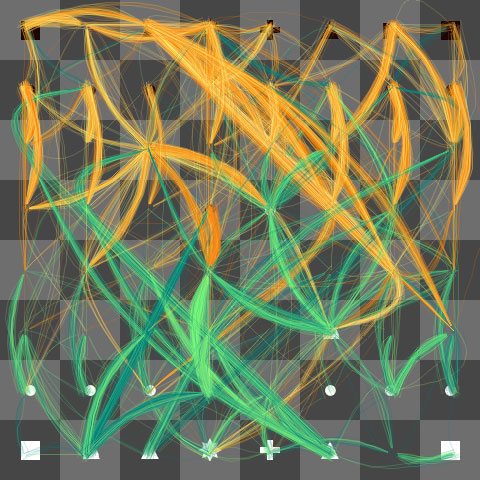 As part of my real (ie non chess) job, I spent part of the year as a tutor for a Digital Media unit at the Australian National University. I was definitely on the Digital side of the course, rather than the Media side, as I struggle with the whole creative process.
The students were required to produce assignments using the Processing language, which is well suited to artistic representation on a computer. Although the course finished a couple of weeks ago, a tie-in with chess came to my attention today. Kerry Stead told me about a web site that had a chess playing program that represented its thinking process in a graphical format. The site is turbulence.org and it uses a chess playing program to create images like the one on the right.
The diagram is generated while the program is deciding on a move. The lines indicate the moves it is examining (green for white, orange for black), and the stronger the move, the brighter the line. The creators confess that the program isn't that strong, but having a strong chess playing program isn't the aim of the website. There are a couple of other little graphical tricks on offer as well, but you need to visit the website to find out what they are.
Monday, 28 November 2011
Another shot at three player chess
Three player chess. Inventive minds have worked for hundreds of year to make it work, but I'm not really sure what problem they're trying to solve. Anyway, there is another attempt at coming up with a workable solution, and if anything, it has a certain artistic appeal. It uses a circular board, a moat to separate the pieces, and lines to mark out the trajectories of the diagonal moving pieces. Of course the old 2v1 problem is likely to rear its head (any player in the lead is likely to be hacked down by a coalition of the other two), and I wonder how this is dealt with (if at all).
I'll add it to my list of 'things that only look like chess' but it still may make a nice Xmas present, if only to leave on the lounge room table.
I'll add it to my list of 'things that only look like chess' but it still may make a nice Xmas present, if only to leave on the lounge room table.
Sunday, 27 November 2011
ACTJCL Transfer Championship
Sixty-eight players (including a number of nervous adults) took part in the 2011 ACT Junior Chess League Transfer Championship. There were a couple of high powered teams (combined ratings over 3000) and number of semi-serious teams (including 2 dressed in cowboy outfits!) while the rest were just there to enjoy themselves.
After 12 rounds three teams finished equal first, with 10 points each. On tie-break first place was awarded to the top seeds Emma Guo and Alana Chibnall, ahead of Harry Press and Michael Kethro, and Allen and Megan Setiabudi. The Setiabuid's picked up a consolation prize as best sibling team.
This year did not see as many 'shady' tricks as last year, although there were still a couple of 'only in transfer' moments. A clash between two of the top finishers saw one player sitting on one board, facing disaster if they moved, while there was a perpetual on the other. So the partner of the sitting player was forced to accede to a 50 fold repetition while her opponent waited until the sitting player had lost enough time to allow him to sit as well!
The other strange thing was there were at least 5 drawn games, in a version of the game where draws are all but impossible.A couple were due to double flag fall, at least one to a simultaneous mate v illegal move claim, and the rest due to confusion about what was going on in the game, leading to the arbiter making a ruling that resulted in the least amount of crying.
Further adventures in Rule 10.2

After the game I suggested that if White had wanted to claim a draw under 10.2 he would do well to try and move a little bit faster than he did in the game, and to try and not give the impression he was playing for two results by lunging towards his opponents pawns.
The point being, if this had been a game where White had claimed a draw under 10.2, but had moved as slowly as he did (more than 5 seconds per move) I would have had no problems in disallowing the claim, even if the position had not substantially changed after White lost on time.
Friday, 25 November 2011
I stand corrected
The Tal Memorial finishes tonight and it has revealed at least one thing to me. Previously I suggested that double round robins encouraged more conservative play than single round robins, in that players were happy to draw with Black and then fight against the same opponent with White (or course their opponent is probably using the same strategy).
However the gathering of 10 of the worlds top players has seen just as many draws, if not more. After 7 rounds there were 5 players tied for first on +1, and in round 8 only Aronian v Svidler was decisive. Of course most of the draws were still pretty hard fought (No draw offers before move 40 is a tournament condition), but lack of decisive games in the later half of the tournament indicates, well, something.
Probably the outstanding result in this regard is Viswanathan Anand's +0=9-0 result. The normal explanation is that he keeps his powder dry for upcoming World Championship matches, but I'm sure Tigran Petrosian is smiling somewhere in the afterlife!
Here is his final round game against his upcoming World Championship challenger Boris Gelfand.
Gelfand, Boris - Anand, Viswanathan
6th Tal Memorial Moscow RUS (9), 25.11.2011
Thursday, 24 November 2011
Which openings have computers killed?
I've played most gambit openings in my time, but one I've not really tried is the Belgrade Gambit (1.e4 e5 2.Nf3 Nc6 3.Nc3 Nf6 4.d4 ed 5.Nd5). It popped up on my radar when I saw it played at last weekends Vikings tournament, but even then I had to wrack my brain to remember what it was.
If my memory isn't failing me, I'm pretty certain it was popular in the 1970's and 80's, even at the top level. However I haven't noticed it so much these days, even with the current fad of digging up old and overlooked lines. So I'm wondering whether it has fallen out of favour due to 'engine disapproval' . Has the march of the machines dealt it a death blow, or is there some other reason why I'm not seeing it. But if it has faded away due to computer improvements, are there any other openings that have suffered a similar fate?
If my memory isn't failing me, I'm pretty certain it was popular in the 1970's and 80's, even at the top level. However I haven't noticed it so much these days, even with the current fad of digging up old and overlooked lines. So I'm wondering whether it has fallen out of favour due to 'engine disapproval' . Has the march of the machines dealt it a death blow, or is there some other reason why I'm not seeing it. But if it has faded away due to computer improvements, are there any other openings that have suffered a similar fate?
Subscribe to:
Posts (Atom)